Most property owners in Orange County don’t think about their asphalt until something goes visibly wrong a crack snaking across the driveway, a pothole swallowing a tire, or a parking lot that’s faded from deep black to a dusty gray. By that point, the damage has been building quietly for years.
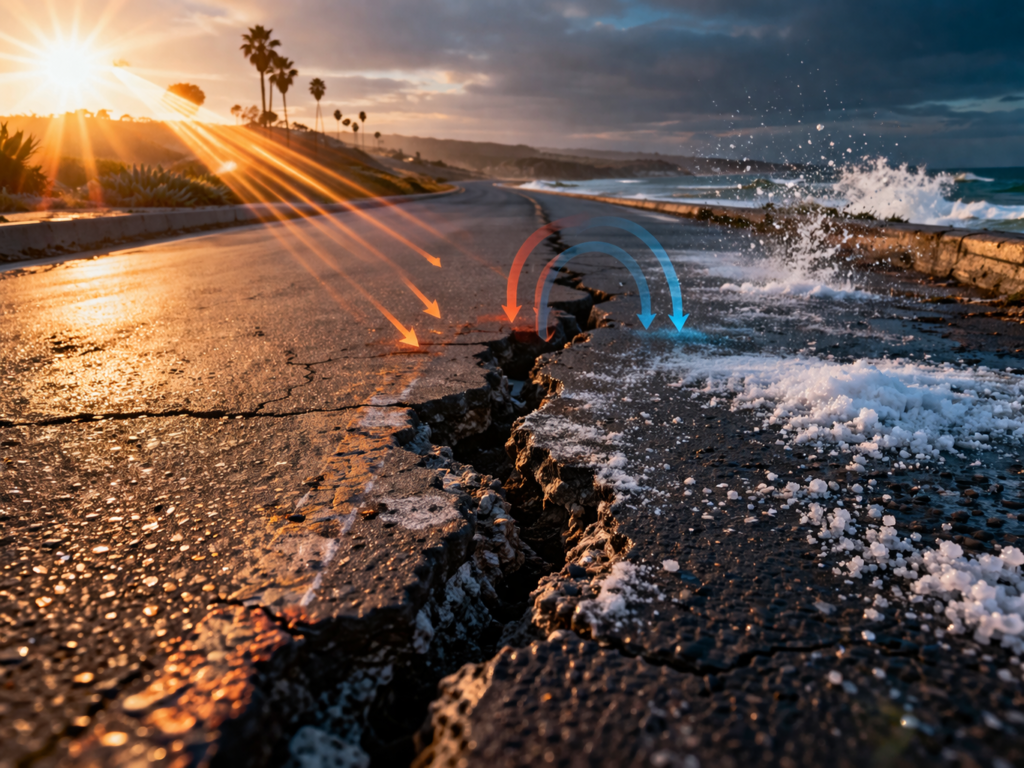
What many people don’t realize is that asphalt is in a constant battle with the environment the moment it’s installed. And in Orange County specifically, three forces are working around the clock to break it down: ultraviolet radiation, coastal salt air, and daily thermal cycling. Understanding what these forces actually do at a molecular level changes the way you think about pavement maintenance entirely.
This article isn’t about selling you on a service. It’s about understanding the science behind why asphalt deteriorates the way it does in Southern California and why sealcoating exists as a direct response to these specific environmental threats.
How Asphalt Actually Works (and Why That Matters)
Before diving into what destroys asphalt, it helps to understand what holds it together. Asphalt pavement is a mix of aggregate crushed stone, gravel, and sand bound together by bitumen, a thick petroleum-based binder. The bitumen acts as the glue. It fills the gaps between aggregate particles, creates a waterproof surface, and gives asphalt its flexibility to handle the weight and movement of vehicles without cracking.
When asphalt is freshly laid, the bitumen is rich in oils that keep the surface flexible and resilient. Over time, those oils evaporate and oxidize. The binder hardens. The pavement becomes brittle. And once brittleness sets in, every other form of damage accelerates.
This is the fundamental process that sealcoating addresses. But in Orange County, the rate of that deterioration is dramatically faster than in cooler, less sun-exposed regions.
UV Radiation: Orange County’s Year-Round Assault on Bitumen
Orange County averages roughly 280 to 290 sunny days per year, with summer temperatures regularly exceeding 90°F. That means your asphalt is absorbing intense ultraviolet radiation almost every single day.
UV rays trigger a chemical reaction called photo-oxidation in the bitumen binder. The oils that keep asphalt flexible begin to break down at the molecular level. The surface dries out, loses its dark color, and turns gray. That color change isn’t just cosmetic it’s a visible indicator that the binder is losing its structural integrity.
Once photo-oxidation advances far enough, the bond between the binder and the aggregate weakens. Small particles of stone and sand start to loosen from the surface. This process, known as raveling, is one of the earliest signs of serious UV damage. You’ll notice it as a rough, sandpaper-like texture where the pavement used to be smooth.
Without intervention, raveling leads to surface erosion, which leads to water infiltration, which leads to base failure. The chain reaction starts with sunlight something Orange County has in abundance.
Salt Air Corrosion: The Coastal Factor Nobody Talks About
Inland property owners often assume salt air is only a concern for beachfront properties. In reality, airborne salt particles from the Pacific Ocean travel several miles inland, and Orange County’s coastal geography means that communities from Huntington Beach and Newport Beach all the way to Irvine and Anaheim experience some degree of salt air exposure.
Salt air doesn’t eat asphalt the same way it corrodes metal, but it does accelerate the oxidation process. Salt particles settle on the pavement surface and draw moisture, keeping the asphalt damp for longer periods. This persistent moisture, combined with the salt’s chemical properties, speeds up the breakdown of the bitumen binder and creates conditions where water penetration becomes more likely.
For properties near the coast, this means the window between sealcoating applications is shorter. What might be a comfortable four-to-five-year cycle for an inland property with shade coverage could shrink to every two to three years for a sun-exposed coastal lot.
Thermal Cycling: The Invisible Stress Test Happening Every Day
Orange County’s climate might seem mild compared to regions with harsh winters, and that leads many property owners to assume their asphalt isn’t under thermal stress. That assumption is wrong.
During summer months, asphalt surface temperatures in direct sunlight can exceed 150°F during the afternoon, then cool to 60–65°F overnight. That’s a temperature swing of nearly 90 degrees in a single day. Asphalt expands when heated and contracts when cooled. These daily expansion-contraction cycles create micro-stresses throughout the pavement structure.
Over weeks and months, these micro-stresses accumulate. Tiny cracks form at the surface invisible to the naked eye at first, but large enough for water to enter. Once water gets beneath the surface, it erodes the base layer. The next thermal cycle expands those cracks slightly more. This is how small, unnoticed damage compounds into potholes and structural failure seemingly overnight.
The key insight here is that Orange County’s thermal cycling happens year-round, not just seasonally. Unlike cold-climate regions where freeze-thaw damage is limited to winter months, the daily heat-cool cycle in Southern California never stops.
What Sealcoating Actually Does at a Material Level
Sealcoating is often described in vague terms like “protective layer” or “barrier.” That’s technically accurate, but it undersells what’s happening.
A sealcoat is a liquid emulsion typically made from refined asphalt or specialized polymers, mixed with mineral fillers, sand, and water that’s applied in thin coats over existing pavement. When it cures, the oils in the sealant seep into the surface of the existing asphalt, replenishing some of the depleted binder oils lost to oxidation. Meanwhile, the fine particles in the sealant fill microscopic pores and hairline cracks, creating a renewed surface that resists water penetration.
The cured sealcoat also acts as a UV shield, absorbing and reflecting ultraviolet radiation before it can reach the underlying bitumen. Think of it as sunscreen for your pavement it doesn’t stop aging entirely, but it dramatically slows the rate of photo-oxidation.
Against salt air, the sealcoat serves as a physical barrier that prevents salt particles from making direct contact with the asphalt binder. And for thermal cycling, the flexibility of a fresh sealcoat allows the surface to expand and contract without cracking.
The Myths That Lead Property Owners Astray
Despite being one of the most well-established pavement maintenance practices, sealcoating is surrounded by persistent misconceptions. Here are the ones that cause the most real-world damage:
“Sealcoating is just cosmetic.”
This is the most common and most costly myth. Yes, sealcoating restores a rich black appearance. But the functional benefits UV protection, water resistance, oil and chemical resistance, binder replenishment are the real reason it exists. Dismissing sealcoating as “paint for your driveway” is like dismissing roof shingles as decoration.
“It will fix my cracks.”
Sealcoating is a preventative treatment, not a repair. It fills micro-pores and hairline surface imperfections, but it cannot bridge existing cracks or level out potholes. Any cracks in the pavement need to be filled with hot rubberized material before sealcoating is applied. Skipping this step is like applying a bandage over a wound without cleaning it first.
“Thicker is better.”
Sealcoat cures through water evaporation, from the top layer down. A thick, single-pass application traps moisture underneath, leading to a surface that stays tacky, tracks into buildings, and can actually crack and flake off. Two thin coats cure faster and more completely than one thick coat and provide better, longer-lasting protection.
“My asphalt looks fine, so I don’t need it yet.”
The entire point of sealcoating is to protect asphalt before visible damage appears. By the time your pavement looks gray and cracked, the underlying binder has already lost significant structural capacity. The ideal approach is to begin sealcoating within the first six to twelve months after installation and maintain a regular cycle from there.
Timing Sealcoating in Orange County’s Climate
Sealcoat requires air and surface temperatures above 50°F for proper curing, along with dry conditions for at least 24 hours after application. In Orange County, this makes late spring through early fall the optimal window.
However, peak summer heat particularly July and August can actually work against you. Surface temperatures above 120°F can cause the sealant to cure too rapidly on the surface while trapping moisture below, creating the same problems as over-application. The sweet spots tend to be April through June and September through mid-November, when temperatures are warm but not extreme and precipitation risk is low.
For most commercial properties in Orange County, a resealing cycle of every two to three years is recommended for sun-exposed lots with heavy traffic. Residential driveways or shaded properties may stretch to three to five years between applications.
The Environmental Shift: Coal Tar vs. Asphalt Emulsion Sealers
One topic worth addressing for Orange County property owners is the type of sealant being used. Traditionally, coal tar-based sealers were the industry standard due to their durability and chemical resistance. However, coal tar contains polycyclic aromatic hydrocarbons (PAHs) compounds that have raised environmental and health concerns as they erode into soil and waterways.
Over 100 local governments across the United States have restricted or banned coal tar sealants. Asphalt emulsion-based sealers have emerged as the primary alternative, offering comparable durability with significantly lower PAH levels. Many California contractors now default to asphalt emulsion products, and it’s worth asking any contractor about the specific products they use.
This isn’t a minor detail. For property owners who care about the environmental footprint of their maintenance decisions and increasingly, for those who need to comply with local regulations the type of sealer matters.
The Bottom Line: Understanding the Science Changes the Decision
When you understand that UV radiation is chemically decomposing your pavement binder every sunny day, that salt air is accelerating that process from the coast inward, and that thermal cycling is mechanically stressing every square foot of your asphalt daily, sealcoating stops looking like an optional cosmetic upgrade. It becomes an obvious response to specific, well-understood environmental threats.
For property owners throughout Orange County whether you’re managing a commercial lot in Anaheim, a retail center in Irvine, or a residential driveway in Mission Viejo the science points in one direction: proactive protection dramatically outlasts reactive repair.
If you’re looking for professional guidance on protecting your asphalt in the Orange County climate, Asphalt Sealcoating Orange County specialists can help you build a maintenance plan tailored to your property’s specific exposure and traffic conditions.